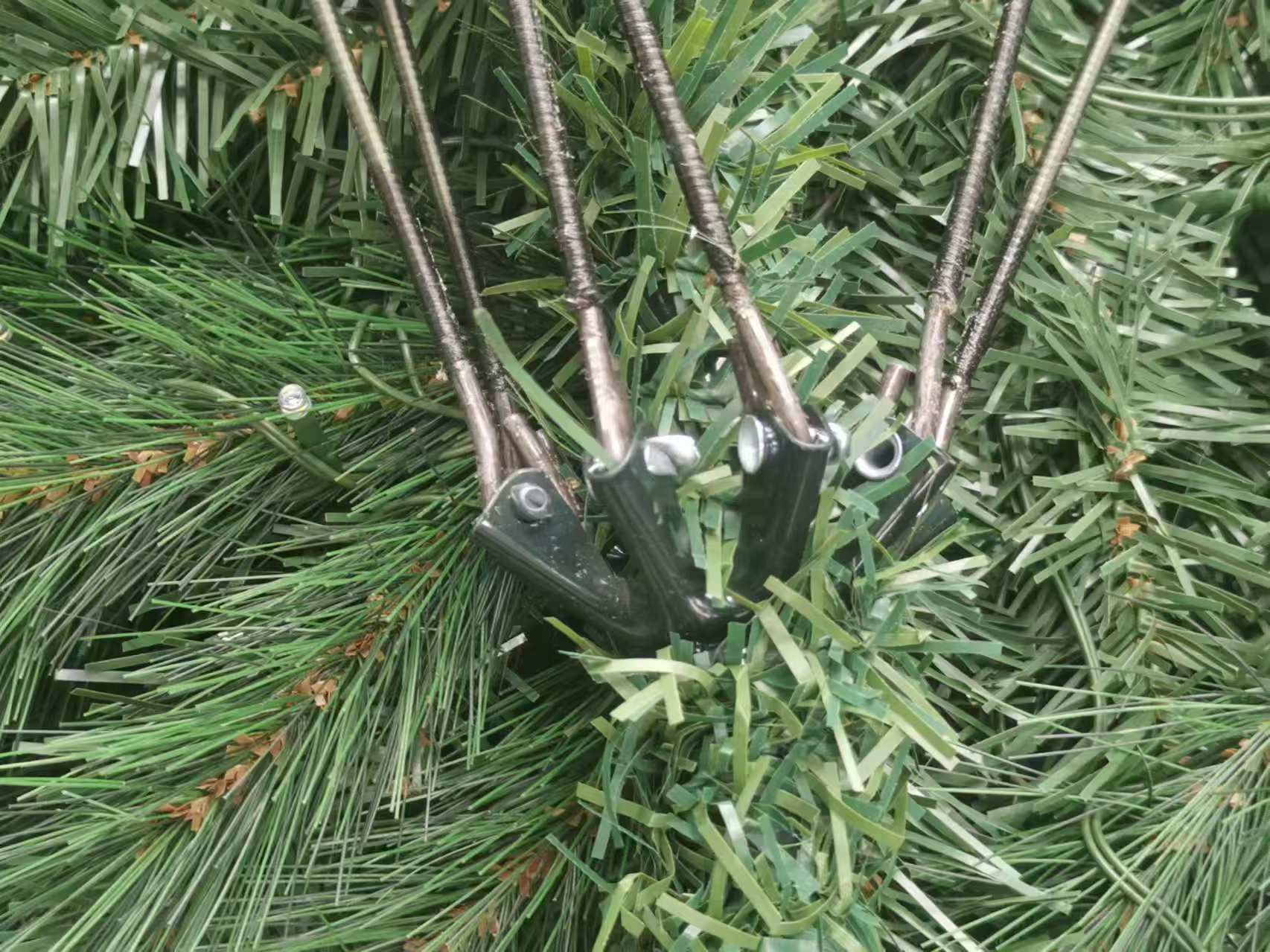
The Christmas tree hub is the hardware ring that sits around the trunk pole of an artificial Christmas tree and holds the branch groups in place. It is the central part of the hinge-style branch assembly: each branch group is pinned to the hub with a hollow rivet, creating a pivot point that lets the branch fold flat for storage and spread out for display.
If you manufacture artificial Christmas trees - whether PVC or PE - the hub is a component you need in bulk, in consistent dimensions, and matched correctly to your trunk pole diameter and branch wire specification. ONE PLASTIC supplies Christmas tree hubs as part of our complete Christmas tree production series, alongside film, machinery, and other assembly hardware.
What an Artificial Christmas Tree Hub Is Used For
In a typical artificial Christmas tree, the trunk is divided into two or three sections. At each section, a metal hub is fixed around the trunk pole to serve as the central anchor point for the branch groups at that tier.
The hub's job is simple but critical:
Distribute branches evenly: The hub has multiple slots or tabs around its circumference, so branch groups radiate out from the trunk at regular intervals
Anchor the branch to the trunk: Each branch group is mechanically fastened to the hub, not to the trunk pole directly
Create a pivot point: Combined with a hollow rivet, the hub allows the branch to rotate - fold down for storage, fan out for display
Transfer load to the trunk: When branches are loaded with ornaments or lights, the weight goes through the branch wire, into the hub, and down to the trunk
Without a properly sized and properly installed hub, the branch assembly becomes the weak point of the finished tree. Loose, misaligned, or poorly manufactured hubs cause the most common quality complaints in artificial Christmas trees: drooping branches, uneven spacing, and branches that detach over repeated setup-and-teardown cycles.
How the Tree Hub Works with Trunk Poles, Branches, and Hollow Rivets
The tree hub does not work alone. It is one component in a small hardware assembly that includes the trunk pole, the branch wire group, and the hollow rivet:
Trunk Pole -> Hub -> Hollow Rivet -> Branch Wire Group -> PVC/PE Foliage
Here is how the assembly goes together:
The trunk pole is cut to length and the hub is slid onto the pole at the correct tier position
The hub is welded, pressed, or pinned onto the pole so it stays in place
The branch wire group (a bundle of twisted steel wire with PVC Christmas tree film or PE needles attached) is positioned into one of the hub's slots
A hollow rivet passes through the hub slot and the branch wire bundle
The rivet is set (flared on the back side), locking the branch to the hub while still allowing it to pivot
This pivot is what makes hinged-style Christmas trees practical. When the consumer pulls the branch outward, it rotates around the rivet axis. When they push it back down, it folds flat against the trunk for storage. Year after year, this hinge is what the tree's service life depends on - which is why the hub, the rivet, and the match between them all matter.
Available Sizes and Specifications
The critical dimensions of a Christmas tree hub are the inner diameter (must match the trunk pole) and the number/position of branch slots (must match the tree design). Common sizes we supply:
| Parameter | Typical Range |
| Inner Diameter | 19 mm, 22 mm, 25 mm, 32 mm (custom sizes available) |
| Outer Diameter | Sized per tree design, typically 60-120 mm |
| Number of Branch Slots | 6 to 12 slots, depending on tree size and branch density |
| Material | Low-carbon steel (standard); stainless steel available on request |
| Surface Treatment | Zinc plated (standard); black oxide, powder coat available |
| Thickness | Typically 1.5-3.0 mm, matched to the hollow rivet being used |
| Installation | Welded, pressed, or pinned to trunk pole |
| Compatibility | Pairs with standard hollow rivets (3-6 mm outer diameter) |
Custom hub designs are available for non-standard tree sizes or special branch configurations. If your tree design requires a specific slot pattern, hub thickness, or inner diameter outside the standard range, contact us with a drawing or sample and we can produce matched hubs.
Hub Size Selection by Tree Size
Choosing the correct hub size depends on three factors: trunk pole diameter, branch count per tier, and tree weight.
| Tree Size | Typical Trunk Pole OD | Typical Hub ID | Typical Branch Slots | Recommended Rivet |
| Tabletop (2-4 ft) | 19 mm | 19 mm | 6-8 slots | 3 mm hollow rivet |
| Medium (5-7 ft) | 22 mm | 22 mm | 8-10 slots | 4 mm hollow rivet |
| Full-size (7-9 ft) | 25-32 mm | 25-32 mm | 10-12 slots | 5 mm hollow rivet |
| Commercial (10+ ft) | 32+ mm | 32+ mm | 12+ slots | 6 mm hollow rivet |
If you are unsure which hub size to order, send us a sample of your trunk pole and branch wire group, and we will recommend a matched hub specification.
PVC Tree and PE Tree Compatibility
The same tree hub design works for both PVC and PE artificial Christmas trees. The hub itself is not affected by the foliage type - it attaches to the branch wire bundle, and the wire bundle carries the PVC film strips or molded PE needles downstream.
What does vary between PVC and PE trees is the branch wire bundle thickness:
PVC Trees: The branch bundle is typically thinner because PVC leaf strips are tied individually to thin branch wires. Hubs for PVC trees often pair with 3-4 mm rivets.
PE Trees: The branch bundle is often thicker because PE injection-molded branches require a stiffer wire core to support the heavier leaves. Hubs for PE trees often pair with 4-5 mm rivets.
If you produce both PVC and PE trees, you can use the same hub design for both, but the rivet specification may differ between tree lines.

Packaging, MOQ, and Custom Options
| Item | Details |
| Standard Packaging | Poly bag, then packed into cartons |
| Carton Load | Typically 20-25 kg per carton |
| Pallet | Cartons palletized, stretch-wrapped |
| MOQ | Typical minimum starts around 10,000 pieces for standard sizes |
| Lead Time | 15-25 days depending on quantity and specification |
| Shipping | Sea freight (FCL and LCL), air freight for urgent orders |
| Custom Stamping | Available - custom slot patterns, hub diameter, and thickness |
| Custom Coating | Powder coat colors available on request |
For Christmas tree production, ordering is typically seasonal - most tree manufacturers place hub orders between March and August for the annual production cycle. We recommend confirming your hub specification and quantity early in the season to lock in production capacity and delivery timing.
Why Choose ONE PLASTIC?
Christmas Tree Industry Specialist: ONE PLASTIC is not a general stamping supplier. We specialize in the artificial Christmas tree supply chain - from PVC Christmas tree film and PE materials to machinery and parts and assembly hardware. When you order tree hubs from us, you are ordering from a supplier who understands how the hub fits into the finished tree.
Matched Hardware System: We supply both hollow rivets and tree hubs. Ordering both from the same supplier means the rivet OD, hub slot thickness, and rivet length are specified together - avoiding the common problem of rivets that do not fit the hub correctly.
Consistent Dimensional Tolerance: Our hubs are produced to consistent inner/outer diameter and thickness tolerances. This matters for automated assembly: hubs that are slightly out of spec cause jams on the assembly line and inconsistent fit on the trunk pole.
Custom Stamping Capability: Beyond standard sizes, we can produce custom hub designs with non-standard slot patterns, inner diameters, or hub thicknesses. Send us a drawing or sample for quotation.
One-Stop Supply for Tree Production: For factories setting up or expanding artificial Christmas tree production, we can supply hubs, rivets, trunk hardware, PVC film, and machinery together - simplifying purchasing and ensuring component compatibility.
Frequently Asked Questions
What is the difference between a Christmas tree hub and a hinge connector?
The two terms are often used interchangeably. Some manufacturers use "hub" to refer specifically to the ring that fits around the trunk pole, and "hinge connector" to refer to the full assembly including the rivet and the pivoting branch wire. In our catalog, the hub is the metal ring, and the hinge assembly is the hub plus hollow rivet plus branch wire.
Can I use the same hub design for multiple tree sizes?
Usually no. Different tree sizes require different trunk pole diameters, different branch counts, and different branch weights - all of which affect hub specification. Most factories use 2-3 different hub sizes across their product line (tabletop, medium, full-size).
How is the hub installed on the trunk pole?
The most common installation methods are welding (spot welding the hub to the pole), pressing (the hub's inner diameter is sized for an interference fit), or pinning (a through-pin locks the hub in place). The method depends on your production line setup and the trunk pole material.
Do you supply tree hubs separately, or only as part of a complete package?
Both. We supply hubs as standalone hardware for factories that already have established assembly lines, and as part of combined orders that include hollow rivets and other tree production components.
Can you produce hubs in custom colors?
Yes. Standard finish is zinc plating, but we can supply hubs in black oxide, powder coat, or other coatings. Custom color hubs are typically specified when the hub remains visible on the finished tree and needs to blend with the branch or trunk color.
What is the minimum order quantity?
Standard hub sizes have a typical MOQ around 10,000 pieces. Custom stamping designs typically require higher minimums due to tooling cost. Contact our sales team with your specification and target quantity for a specific quote.
Get a Quote
Need tree hubs for your artificial Christmas tree production?
Send Your Specification - Inner diameter, slot count, thickness, and quantity
Request Samples - We can send hub samples for fit testing on your trunk pole
Get a Combined Quote - If you also need hollow rivets or other tree components, we can provide a single quotation
Contact: operation@one-plastic.com
Related Products: Christmas Tree Production Series | Hollow Rivets for Christmas Tree Assembly | PVC Christmas Tree Film | Machine Parts
Related Resources: The Production Process of Artificial Christmas Trees | Contact Us