Anti-fog PET sheet is a transparent PET film with a hydrophilic coating applied to one or both surfaces. The coating spreads condensation into an invisible water film instead of letting it form fog droplets - which means the sheet stays clear when exposed to refrigeration, steam, or breath, even after temperature transitions that would make standard PET sheet visibly fog up.
This matters most in two commercial settings: food packaging where the product needs to stay visible through cold-chain temperature changes, and protective face shields where a clear line of sight is a safety requirement. Both of these end-uses are poorly served by standard PET, which fogs readily under humid or cold conditions.
This page is the main reference for our anti-fog PET sheet material. For a broader overview of our full PET product line, see our main anti-fog PET plastic sheet category page. For converting-specific supply (pre-slit, stack-packed anti-fog PET ready for die cutting), see our die cutting anti-fog PET sheet film variant.
What Anti-Fog PET Sheet Is
Anti-fog PET sheet is built from two parts:
Base PET Sheet: A standard amorphous PET (APET) substrate with high clarity, good rigidity, and strong thermoforming behavior. This is the same base material used in clear food trays, blister packs, and cold-chain packaging.
Anti-Fog Coating: A thin hydrophilic coating applied after extrusion. The coating changes the surface energy of the sheet so that water condensation spreads flat rather than beading into fog droplets. This is what preserves optical clarity under humid or cold conditions.
Anti-fog treatment is available one-side or two-sides depending on the application. One-side anti-fog is typical for food packaging lids (where only the inside surface faces the product). Two-side anti-fog is typical for face shields and visors (where both surfaces are exposed to humidity).
Key Features of Anti-Fog PET Sheet
High Transparency: Light transmittance typically above 88%, with haze below 3% - virtually indistinguishable from standard clear PET in normal viewing conditions
Fog Resistance: Maintains clear visibility under refrigeration, condensation, or breath exposure where standard PET would fog up
Temperature Tolerance: Performs in cold-chain environments down to approximately -8 C and at standard ambient temperatures
Thermoformable: Can be vacuum-formed or pressure-formed into trays, lids, and clamshell containers without losing anti-fog function
Food-Contact Grades Available: Can be produced to meet food-contact requirements, depending on the specific coating and grade (contact us to confirm for your application)
Print-Friendly: Compatible with UV and standard printing inks for branded packaging applications
Die-Cut Friendly: Clean cutting behavior for converting into face shields, visors, and flat protective covers
Recyclable: PET #1 recyclable
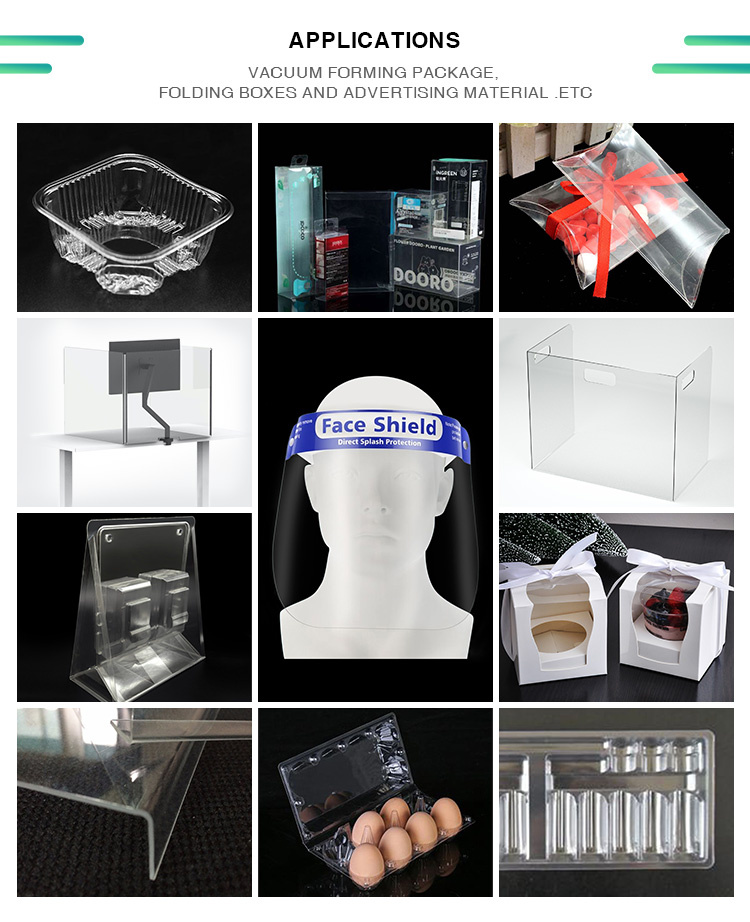
Food Packaging, Face Shield, and Visibility-Critical Applications
The commercial case for anti-fog PET sheet is strongest in three application groups:
Food Packaging (Cold-Chain and Humidity-Exposed)
This is the largest commercial use of anti-fog PET. Typical products include:
Fresh-cut fruit and vegetable trays
Deli containers, salad boxes, and ready-meal packaging
Bakery and confectionery packaging
Meat and seafood trays with clear lids
Dairy product containers
Ice cream lids and frozen food lids
In all of these, the package needs to stay visually clear through the retail cold chain. Standard PET fogs on display when moving between chilled and ambient environments, which hides the product and hurts sales. Anti-fog PET preserves product visibility.
Face Shields and Protective Visors
Medical, industrial, and consumer face shields. Without anti-fog treatment, a face shield fogs from the wearer's breath within seconds of being worn - making it unusable for extended tasks. Anti-fog PET is the standard material for face shield manufacture because it stays clear under breath exposure.
Display and Visibility-Critical Covers
Refrigerator shelf covers, cold-display cases, clear signage in humid environments, and any converted clear-panel product where fog would defeat the purpose of the window.
For a deeper technical discussion of how anti-fog coatings work and how to maintain clarity over the product's service life, see our guide on anti-fog PET plastic sheet maintenance.
Approximately -8 C to +60 C for anti-fog performance
Food Contact
Food-grade options available, subject to coating and formulation - contact us to confirm for your application
Supply Format
Sheet, roll, or pre-slit stacks for die-cutting
For thicker or thinner gauges outside our standard range, contact us with your target specification.
How This Page Differs from Die-Cutting Anti-Fog PET Variants
If you are converting anti-fog PET into face shields or cut-to-shape protective covers via high-volume die cutting, the supply format matters. For that specific workflow - where sheets need to be pre-slit, stack-packed, and dimensionally consistent for feed into die presses - we have a dedicated die cutting anti-fog PET sheet film variant.
The underlying material is the same. What differs is the supply format and packaging:
Factor
This Page (Main Anti-Fog PET)
Die-Cutting Variant
Supply Format
Roll, sheet, or cut-to-size
Pre-slit, stack-packed sheets
Typical Buyer
Packaging converter, thermoformer, general PET buyer
High-volume die-cut face shield producer
Typical Thickness
0.15mm - 1.0mm
Typically 0.25mm
Main Use
Food packaging, thermoforming, general anti-fog applications
Die-cut face shields and visors
If your application is food packaging, thermoforming, or general anti-fog sheet supply, this page is the right fit. If your application is specifically high-volume die cutting of face shields or visors, the die-cutting variant is the better match.
Why Choose ONE PLASTIC?
Full PET Family from One Factory: We produce APET, PETG, GAG, RPET, and anti-fog PET on the same production site. If you source multiple PET materials, they can come from a single supplier with coordinated delivery and consistent quality. For a broader view of our PET product line, see our main PET plastic sheet page.
One-Side and Two-Side Anti-Fog: We produce both configurations depending on application. One-side is more economical for food packaging lids. Two-side is specified for face shields and applications where both surfaces face humidity.
Supply in Sheet, Roll, or Cut-to-Size: Anti-fog PET is available in whatever format your production line requires - continuous roll for thermoforming feeds, cut sheets for sheet-fed operations, or pre-slit stacks for die-cutting.
ISO 9001 Certified: Routine batch testing is performed for thickness tolerance, haze, light transmittance, and surface quality. Test reports are available on request.
Custom Thickness and Width: Beyond standard sizes, we can produce anti-fog PET to your exact thickness and width specification.
Frequently Asked Questions
How long does the anti-fog coating last?
Anti-fog performance depends on use and cleaning conditions. The coating is designed to provide long-term anti-fog behavior for the expected service life of typical food packaging and face shield applications. For best performance, avoid abrasive cleaners, harsh solvents, and ammonia-based products, which can degrade hydrophilic coatings over time.
Is anti-fog PET safe for direct food contact?
Food-grade anti-fog PET is available, but food-contact suitability depends on the specific coating formulation and grade. Contact us with your application details - including the food type, contact temperature, and regulatory region (FDA, EU, etc.) - and we can confirm which grades are appropriate.
Can anti-fog PET be thermoformed?
Yes. The anti-fog coating is designed to survive the heat and stretch of standard vacuum and pressure forming processes. Most food packaging trays and lids using anti-fog PET are made by thermoforming.
What is the difference between one-side and two-side anti-fog?
One-side anti-fog has the hydrophilic coating on a single surface - usually the inside surface of a package lid facing the food. Two-side anti-fog has coating on both surfaces - needed for face shields, visors, and any application where both faces are exposed to humidity. One-side is more economical; two-side is specified when the application requires it.
Can I print on anti-fog PET?
Yes, on the non-coated side (or on a two-side anti-fog sheet, on either side with appropriate ink). UV inks and standard packaging printing processes are compatible. Print adhesion is typically good without primer, but we recommend testing your specific ink system on a sample before committing to a bulk production run.
What thickness should I order?
0.20-0.25mm: typical for face shields and lightweight protective covers
0.25-0.35mm: typical for food packaging lids and thermoformed trays
0.50mm and above: heavier thermoformed containers, display covers
If you are unsure which thickness suits your application, contact us with a description of the intended use and we can recommend a starting specification.
What is the minimum order quantity?
MOQ depends on thickness, width, coating configuration, and supply format. For standard anti-fog PET in common sizes, MOQ is typically manageable for mid-size converters. Contact us with your specific requirements for a quote.
Get a Quote
Looking for anti-fog PET sheet for food packaging, face shields, or other visibility-critical applications?
Tell Us Your Application - Food packaging, face shield, thermoforming, or die-cutting
Specify Thickness and Format - Sheet, roll, cut-to-size, or pre-slit stacks
Request Samples - Evaluate clarity, anti-fog performance, and thermoforming behavior before bulk order