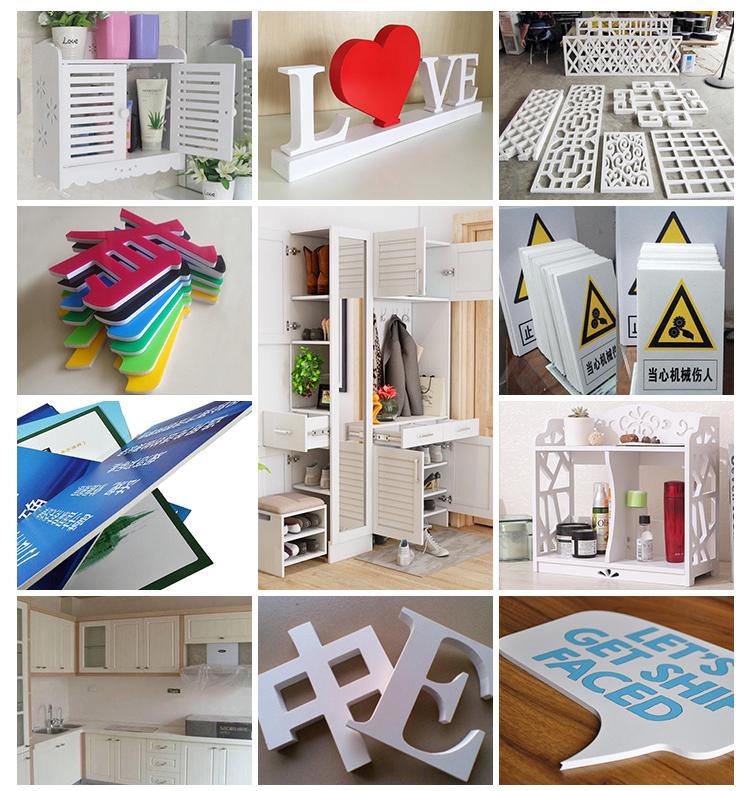
PVC Celuka foam board is a rigid PVC board produced using the Celuka extrusion process, which creates a denser, harder outer skin on both surfaces of the board while the interior remains a lightweight foamed core. The term "Celuka" refers specifically to this co-extrusion manufacturing method - named after the Celuka process developed for producing skinned PVC foam profiles. In practice, PVC Celuka foam board and PVC co-extruded foam board describe the same type of product.
If you have already seen our PVC co-extruded foam board page, this page covers the same material category under its industry process name. Buyers searching for "Celuka board" or "Celuka foam board" are looking for the same product that others may call "co-extruded foam board" or "skinned foam board."
ONE Plastic manufactures PVC Celuka foam board on dedicated co-extrusion production lines as part of our broader PVC foam board product range. We supply Celuka board to furniture manufacturers, cabinet makers, sign fabricators, and construction companies worldwide.
Material: Rigid PVC, Celuka (co-extruded) process
Structure: Hard solid skin on both surfaces + lightweight foamed core
Thickness: 3mm - 30mm
Standard Sheet Size: 1220 x 2440 mm (4' x 8')
Surface: Smooth, hard, consistent on both sides
Color: White (standard); custom colors available
Density: Typically 0.55 - 0.80 g/cm3 (varies by thickness)
Flame Rating: Self-extinguishing
What Is the Celuka Process?
The Celuka process is a specific PVC extrusion method that produces a board with a distinct two-zone cross-section: a solid, dense outer skin and a lighter, foamed interior core. During extrusion, the outer layer of PVC solidifies rapidly against the calibrator surface before the core has time to fully foam, creating a natural density gradient - denser at the surface, lighter in the middle.
This is different from standard free-foaming (expanded) PVC foam board, where the entire cross-section has a uniform cellular structure and no distinct skin layer.
The practical result of the Celuka process is a board that behaves more like solid PVC on the outside - smooth, hard, scratch-resistant, and capable of holding screws and accepting laminate - while remaining lighter and more economical than solid PVC sheet on the inside.
Why this matters to buyers: When you see product listings for "Celuka board," "co-extruded foam board," or "skinned foam board," they are all referring to boards made with this same dual-density process. The term used varies by region and supplier, but the product characteristics are equivalent.
Why Buyers Choose PVC Celuka Foam Board
PVC Celuka foam board is chosen over standard expanded foam board in applications where surface quality, edge finish, and mechanical fastening performance are priorities.
Harder, Smoother Surface: The Celuka skin layer provides a notably harder surface than standard expanded foam board. This means better scratch resistance, smoother painted or laminated finishes, and a more professional appearance in exposed applications.
Cleaner Cut and Routed Edges: When CNC-routed, sawed, or drilled, Celuka board produces cleaner, more consistent edges compared to standard foam board. The skin layer at the edge gives the cut face a more solid appearance, which is important for dimensional letters, sign fabrication, and furniture components where edges are visible.
Better Screw and Fastener Retention: The denser skin provides a firmer anchor for screws and mechanical fasteners. This is a key advantage in furniture, cabinet, and door panel applications where hinges, handles, and shelf supports need to hold securely.
Good Surface for Finishing: Celuka board's smooth, non-porous skin accepts PVC laminate, vinyl wrap, paint, and wood veneer with good adhesion, generally requiring less surface preparation than standard expanded board.
Lightweight Core: Despite the harder skin, the foamed core keeps overall weight well below solid PVC, reducing material cost, shipping weight, and installation effort.
Moisture and Chemical Resistant: Like all PVC foam boards, Celuka board offers excellent moisture resistance. It is highly resistant to swelling, rot, and mold growth under normal use conditions, making it suitable for kitchens, bathrooms, and humid environments.
")
Specifications
| Parameter | Specification |
| Material | Rigid PVC, Celuka process (co-extruded solid skin + foamed core) |
| Thickness | 3mm, 4mm, 5mm, 6mm, 8mm, 10mm, 12mm, 15mm, 18mm, 20mm, 25mm, 30mm |
| Standard Sheet Size | 1220 x 2440 mm (4' x 8') |
| Custom Sheet Size | Available upon request |
| Surface | Smooth, hard Celuka skin on both sides |
| Color | White (standard); custom colors available |
| Density | Typically 0.55 - 0.80 g/cm3 (varies by thickness and grade) |
| Water Absorption | Very low (closed-cell structure) |
| Flame Rating | Self-extinguishing |
Where PVC Celuka Foam Board Is Used
PVC Celuka foam board serves the same applications as co-extruded foam board (since they are the same product). The most common end uses include furniture and cabinet manufacturing (kitchen cabinets, bathroom vanities, wardrobe panels), construction and interior cladding (wall panels, ceiling panels, door surrounds, wet room linings), sign fabrication (CNC-routed dimensional letters, engraved signage), and industrial applications (vehicle interior panels, clean room surfaces).
For a detailed breakdown of applications, thickness recommendations, and use-case guidance, see our PVC co-extruded foam board page, which covers the same product under its buyer-facing name. For projects specifically using PVC foam board as interior door panels, see our PVC foam board for door panels page.
PVC Celuka Board vs. Standard Expanded Foam Board
| Property | Celuka Board | Standard Expanded Board |
| Surface | Hard solid skin - smooth, dense | Uniform foam - softer surface |
| Edge Quality (cut/routed) | Clean, solid-looking edges | May show cellular structure |
| Screw Holding | Better - skin provides firm grip | Weaker |
| Surface for Laminate/Paint | Better - smoother, less porous | Good but may need more preparation |
| Weight | Slightly heavier | Lighter |
| Cost | Moderate | Lower |
| Best For | Furniture, cabinets, fabrication, high-end signage | Printing, displays, lightweight panels |
For applications where standard expanded foam board is sufficient - such as UV-printed signage, lightweight displays, and cost-sensitive panel work - our standard PVC foam board range offers a more economical option.
Celuka Board Terminology Guide
The same product is sold under several names depending on the supplier, region, and industry. This table clarifies the most common terms:
| Term | What It Means | Same Product? |
| PVC Celuka foam board | Named after the Celuka extrusion process | Yes - this product |
| PVC co-extruded foam board | Named after the co-extrusion manufacturing method | Yes - same product, different name |
| Skinned PVC foam board | Describes the hard outer skin characteristic | Yes - same product, different name |
| PVC Celuka board | Shortened form of PVC Celuka foam board | Yes - same product |
| PVC foam board (standard / expanded / free-foamed) | Uniform cellular structure, no skin layer | No - different product type |
| Solid PVC sheet | Non-foamed, fully solid PVC | No - different product type |
If a buyer or specification document asks for any of the terms in the "Yes" column above, they are requesting the same type of board that ONE Plastic manufactures on our co-extrusion line.

Processing Notes
PVC Celuka foam board is processed using the same tools and methods as any co-extruded PVC foam board. It can be cut with table saws, circular saws, CNC routers, and jigsaws. It accepts PVC laminate, vinyl wrap, paint, UV printing, and PVC edge banding. It bonds with PVC solvent cement, construction adhesive, and cyanoacrylate, and holds screws well when pilot holes are used.
Laser cutting is not recommended for PVC. PVC releases harmful and corrosive gases when processed with a laser. Use mechanical cutting methods.
For detailed processing tables covering cutting, finishing, edge treatment, and fastening methods, see our PVC co-extruded foam board page.
Why Choose ONE PLASTIC for Celuka Board?
Dedicated Celuka Production Line: We manufacture PVC Celuka foam board on dedicated co-extrusion equipment, not repurposed free-foam lines. This helps ensure consistent skin thickness, surface hardness, and board quality.
Full Foam Board Range: In addition to Celuka board, we also produce standard expanded PVC foam board and high density PVC foam board, so you can source the right board type for each application from a single factory.
Virgin PVC Resin: We use virgin material to help ensure consistent surface quality, density, and color.
ISO 9001 Certified: Batches are tested for thickness tolerance, surface hardness, density, and dimensional accuracy before shipment.
Custom Options: Custom thickness, sheet size, color, and density grade are available. Contact our team with your requirements.
Packaging and Delivery
| Item | Details |
| Surface Protection | PE film on both sides |
| Packaging | Stacked on export plywood pallet with corner protectors and stretch wrap |
| Pallet Load | Approximately 1,000 kg per pallet |
| Lead Time | Typically 10-15 days after order confirmation |
| Shipping | Sea freight (FCL & LCL), air freight, or land transport |
| Marks | Neutral packing; custom printed marks available |
Frequently Asked Questions
What is the difference between Celuka foam board and co-extruded foam board?
They are the same product. "Celuka" is the name of the co-extrusion process used to produce PVC foam board with a hard outer skin and foamed inner core. Different suppliers and regions use different terminology - Celuka board, co-extruded board, and skinned foam board all refer to boards made using this same manufacturing method.
How is Celuka foam board different from standard PVC foam board?
Standard PVC foam board (also called free-foamed or expanded board) has a uniform cellular structure throughout, with no distinct skin layer. Celuka foam board has a denser, harder outer skin produced during the co-extrusion process. This gives Celuka board better surface hardness, screw retention, and edge quality, making it more suitable for furniture, cabinetry, and fabrication applications.
Can PVC Celuka foam board replace MDF?
In many interior applications, yes. Celuka board offers comparable surface smoothness and lamination compatibility to MDF, with significant advantages in moisture resistance, lighter weight, and high resistance to termite and rot damage. It is widely used as an MDF replacement in kitchen cabinets, bathroom furniture, and door panels, particularly in humid climates.
What thicknesses are available?
We offer PVC Celuka foam board in thicknesses from 3mm to 30mm. The standard sheet size is 1220 x 2440 mm. Custom thicknesses and sheet sizes are available upon request.
Can Celuka board be CNC-routed?
Yes. CNC routing is one of the key use cases for Celuka board. The solid outer skin produces cleaner, more consistent edges compared to standard foam board, which is why sign fabricators and furniture manufacturers choose Celuka board for applications where routed edges are visible.
Is PVC Celuka foam board waterproof?
The closed-cell PVC structure offers excellent moisture resistance. Celuka board is highly resistant to swelling, warping, and mold growth under normal moisture exposure, making it well-suited for kitchen, bathroom, and wet room applications.
Get an Instant Quote
Looking for a PVC Celuka foam board supplier?
Request Samples - Evaluate surface hardness, edge quality, and finish compatibility
Get a Custom Quote - Tell us your thickness, sheet size, and quantity
Speak to a Product Expert - Contact us via WhatsApp or email for technical support
Contact: operation@one-plastic.com
Related Products: PVC Co-extruded Foam Board | PVC Foam Board (Full Range) | High Density PVC Foam Board | PVC Foam Board for Door Panels
Related Resources: Quality Control & Certifications | About ONE PLASTIC | Contact Us