If you are printing on rigid plastic sheet and the ink is beading, peeling, or cracking at the fold line, the problem is almost never the ink or the press. It is the substrate surface.
This guide answers the three questions printers and packaging buyers search for most often: why ink does not stick to PVC sheet, how to improve ink adhesion on PET sheet, and what corona treatment does for printing on plastic. We also include a troubleshooting table so you can diagnose problems fast and a material selection checklist for sourcing printable-grade PVC and PET.
Why Ink Does Not Stick to PVC and PET Sheet
The root cause is surface energy. Paper is porous and naturally ink-receptive, with high surface energy. Untreated rigid plastic — whether PVC clear sheet or PET sheet — has a smooth, non-porous surface with low surface energy, typically 30–36 mN/m for PVC and 41–44 mN/m for PET. Standard offset and UV inks need at least 38–42 mN/m to wet out and bond properly.
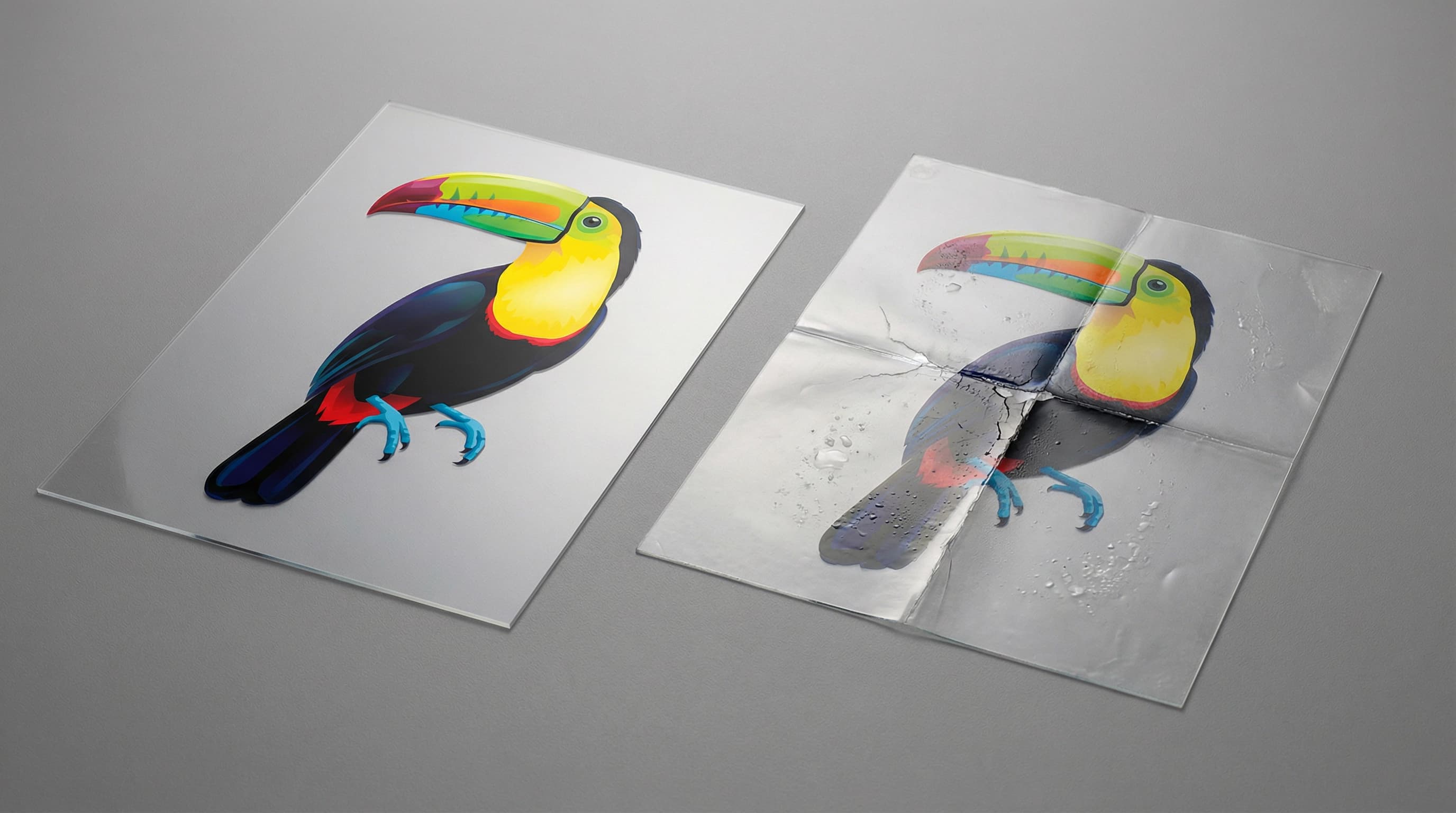
When surface energy is too low, you get one of three failures: ink crawls and beads on press (poor wetting), ink transfers but lifts off in the delivery pile (poor adhesion), or ink cracks when the sheet is scored and folded (poor flexibility bond).
The fix is surface pre-treatment — and for rigid plastic sheet, corona treatment is the industry standard.
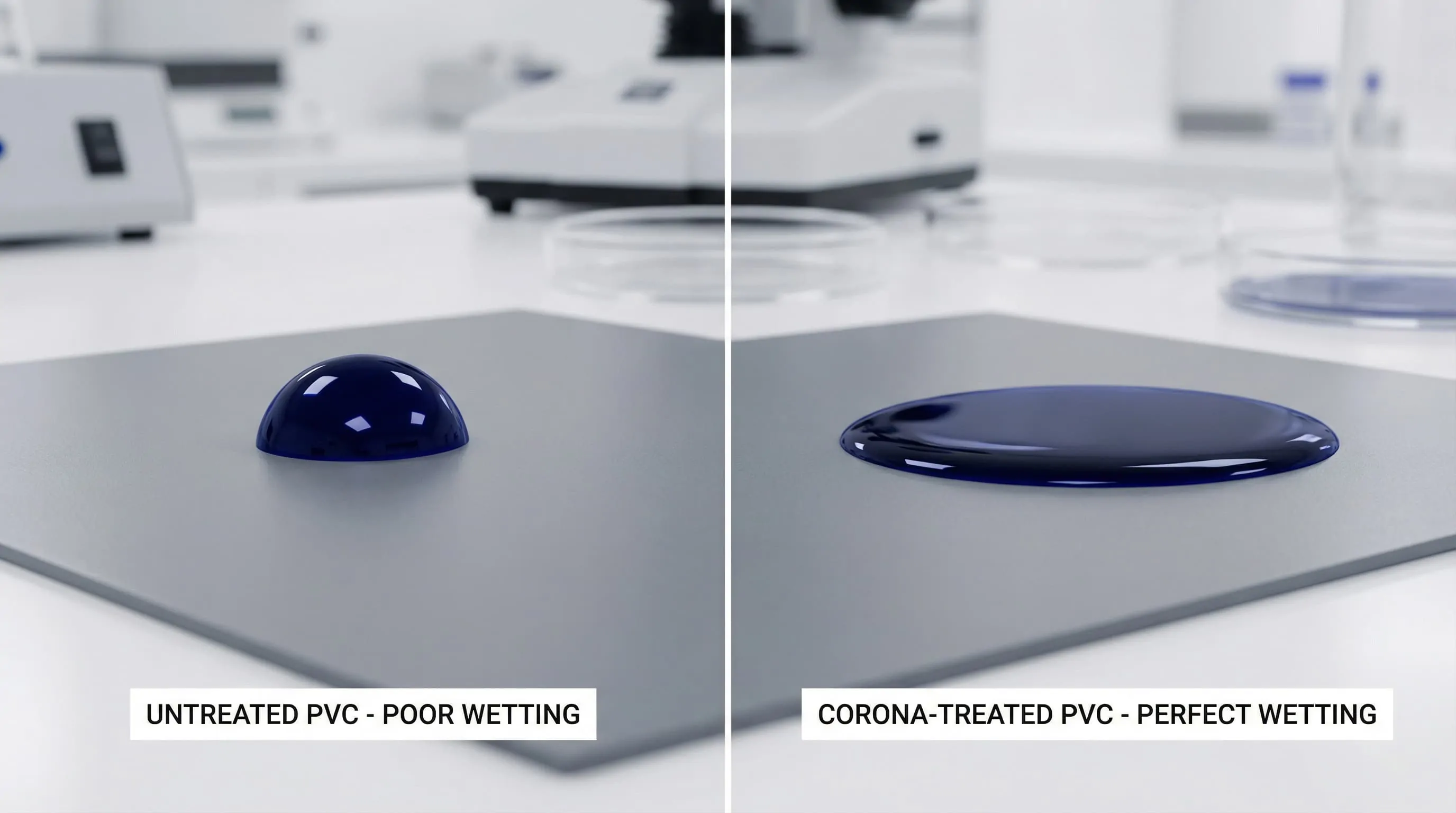
How Corona Treatment Improves Printing on PVC and PET Sheet
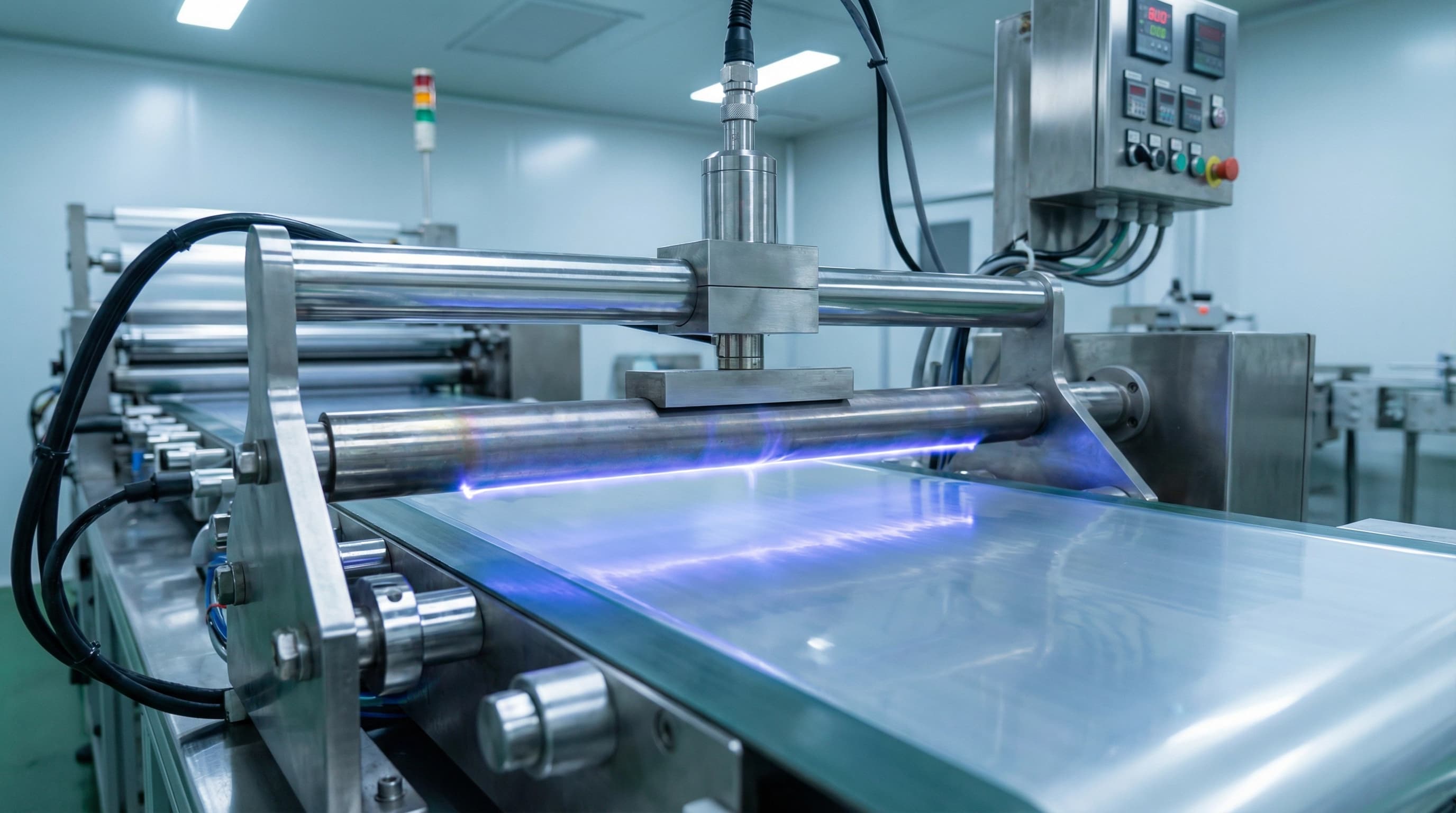
Corona treatment passes the plastic sheet through a high-frequency electrical discharge that does two things at the molecular level. First, it oxidizes the surface by introducing polar functional groups (carbonyl, carboxyl, hydroxyl) that raise surface energy — typically from 32–36 mN/m to 44–52 mN/m on PVC, and from 41–44 mN/m to 48–54 mN/m on PET. Second, it microscopically roughens the surface, creating more mechanical anchor points for ink.
The result is that ink wets out completely, bonds firmly, and survives lamination, folding, and downstream converting.
Corona Treatment Levels for Different Printing Methods
| Printing method | Minimum surface energy required |
| Solvent-based screen printing on PVC | 38 dyne/cm |
| UV offset on rigid PVC sheet | 42 dyne/cm |
| Water-based flexo on PET film | 44 dyne/cm |
| High-adhesion UV on APET / PETG sheet | 48 dyne/cm |
| Lamination bonding over print | 50+ dyne/cm |
Corona Treatment Decays Over Time
This is the detail many printers learn the hard way. Corona treatment is not permanent. Surface energy drops as treated polymer chains re-orient back toward lower-energy states — a process accelerated by heat, humidity, and prolonged storage. A sheet that tested 46 dyne/cm at the factory can fall to 38–40 dyne/cm after 30–60 days in storage.
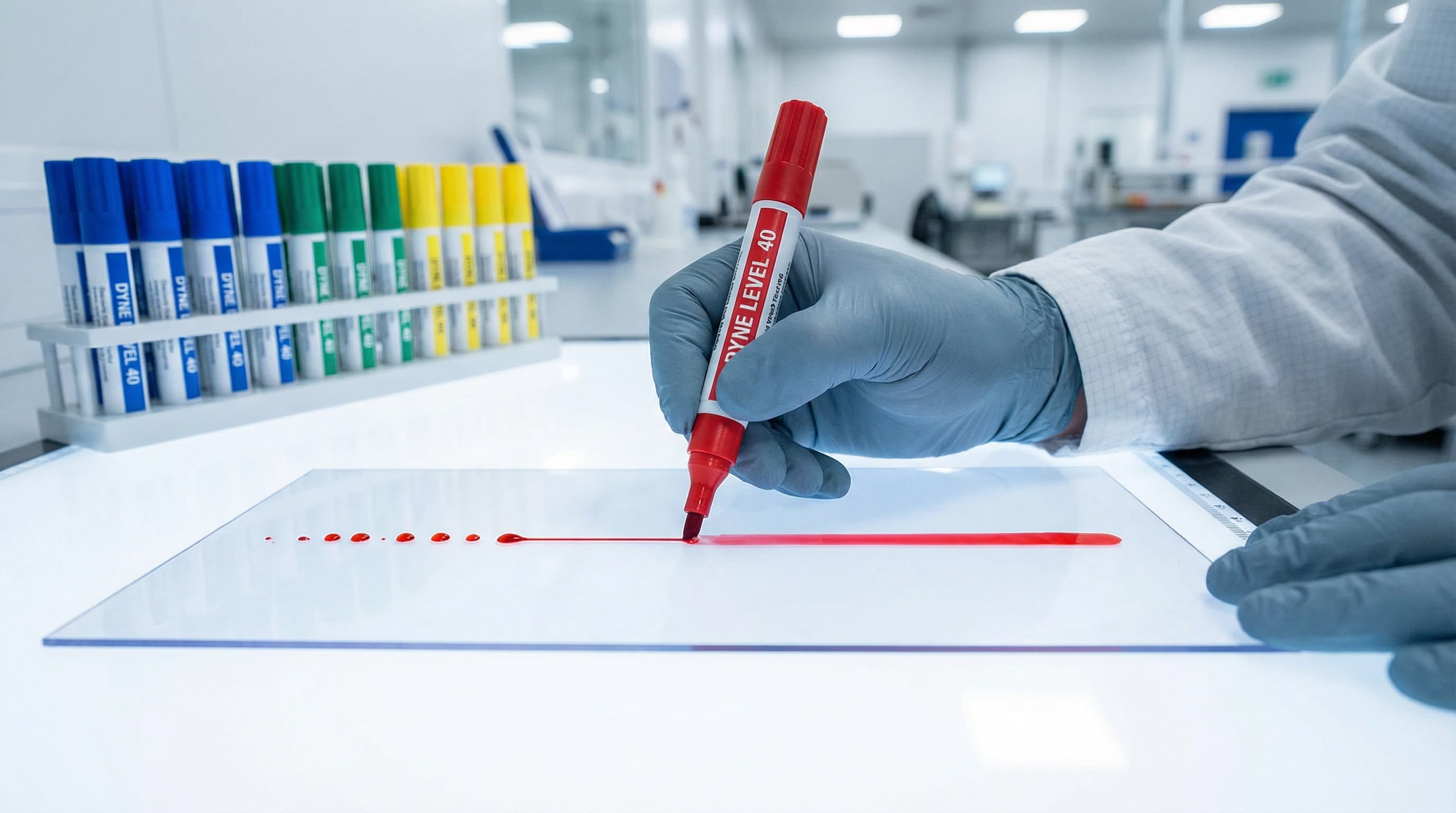
How to manage decay: print within 30 days of receiving treated substrate, store at 15–25°C and 40–60% RH away from UV and chemical vapors, use in-line corona retreatment on press for high-spec jobs, and build a 2-minute dyne pen test into every job setup.

Printing on PVC Sheet: What to Specify
Not all PVC sheet works well for printing. Calendering process, resin grade, plasticizer content, and surface finish all affect how the sheet takes ink.
Thickness tolerance. For offset printing, rigid PVC typically runs 0.20–0.50mm for folding carton windows and up to 0.80mm for rigid boxes. Tight tolerance (±0.02mm) is critical for consistent ink impression.
Surface smoothness. A low Ra (roughness average) on the print side gives cleaner halftone dot reproduction and higher gloss. Specify a polished-roll surface for the print side.
Plasticizer migration. Excess plasticizer migrating to the surface can soften the ink bond over time — the classic "adhesion fails after 48–72 hours" problem. For print-first workflows, specify low-migration or plasticizer-free PVC grades.
Pre-applied corona treatment. The most reliable approach is ordering PVC sheet that has already been corona-treated to your required dyne level at the factory. One Plastic's PVC clear sheet for printing applications is available with controlled surface energy verified per batch.
Printing on PET Sheet: What to Specify
PET sheet is increasingly chosen for premium print packaging because of its superior clarity, dimensional stability under press heat, and recyclability. PET's baseline surface energy (41–44 mN/m untreated) is higher than PVC's, so it is somewhat more naturally ink-receptive — but corona treatment is still required for reliable adhesion in offset and UV offset work.
Treatment level. Specify minimum 48 dyne/cm for UV offset and 50+ dyne/cm for lamination-over-print applications.
Treatment uniformity. Cross-web variation should stay within ±2 dyne/cm. Uneven treatment causes visible banding in ink coverage.
Gauge consistency. For multi-up sheet-fed offset, thickness variation must be tightly controlled. Specify ±0.01mm tolerance for critical register work.
Clarity. If the substrate shows through to the product, specify maximum haze percentage. One Plastic's APET sheet achieves up to 89% light transmission with excellent surface uniformity, and is available with printing-grade corona treatment on request. PETG sheet is another option for applications requiring deeper forming after printing.

Anti-Static Treatment: Solving Feed and Contamination Problems
Corona treatment raises surface energy — but it also increases static charge on the sheet. Static on rigid plastic causes three problems during printing: sheets clinging together in the feeder (misfeeds and doubles), disrupted ink film uniformity, and attraction of airborne dust and fibers that embed in wet ink as hickeys and spots.
PVC is a strong insulator, so static accumulates and dissipates slowly — especially in low-humidity pressrooms below 40% RH.
Solutions, from most to least reliable:
Anti-static coating at source — the best option. One Plastic offers anti-static grades of rigid PVC sheet with permanent charge dissipation incorporated into the surface layer during production.
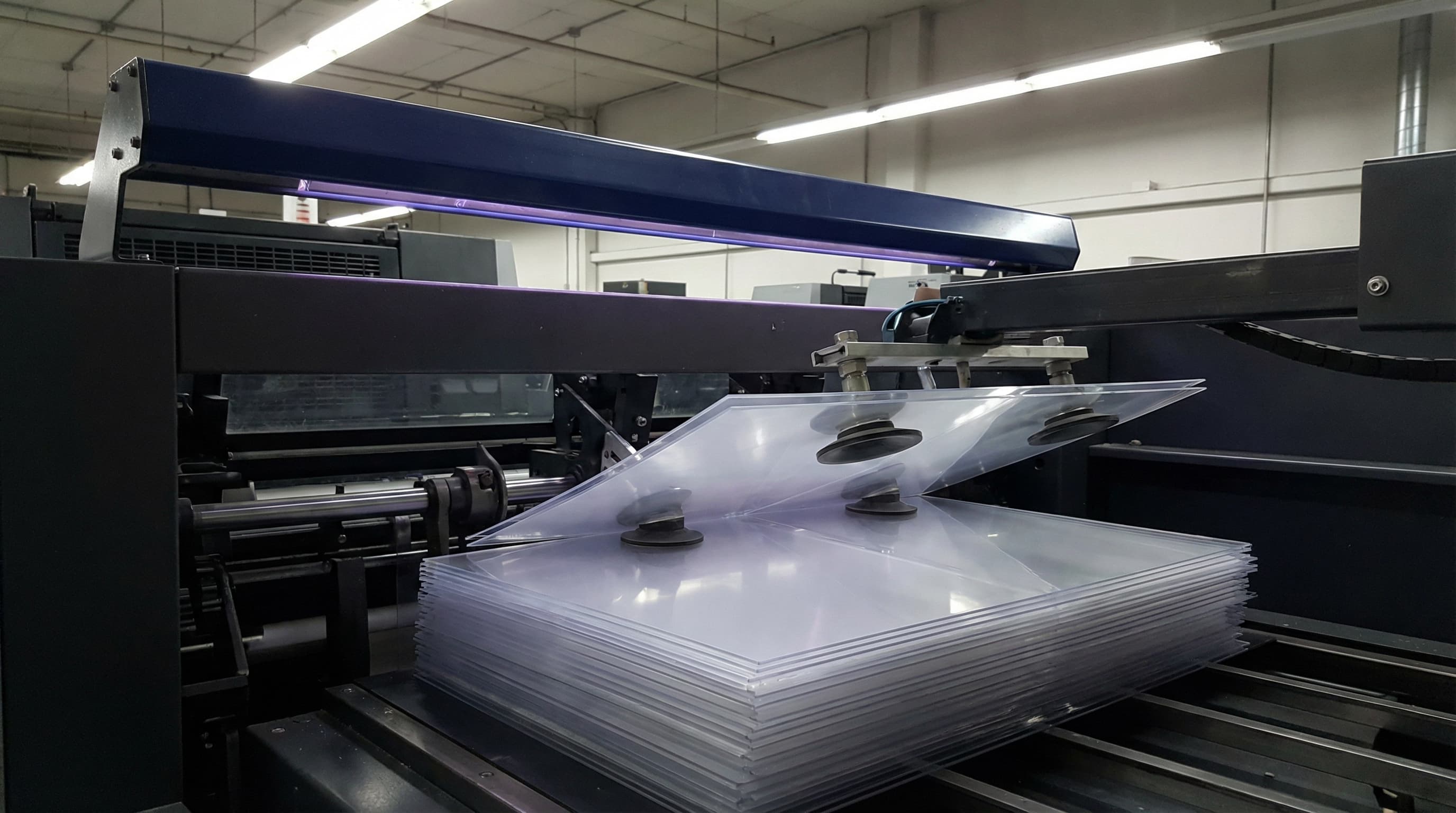
In-line ionizing bars — standard equipment for any press running rigid plastic. Mount at feeder, delivery, and pile positions.
Pressroom humidity control — maintain 45–55% RH. Below 40%, static on insulating substrates becomes unmanageable regardless of other measures.
Anti-static sprays — acceptable for occasional plastic jobs, but over-application can reduce ink adhesion.

Troubleshooting Table: Common Ink Adhesion Problems on Plastic Sheet
| Problem | Likely cause | Fix |
| Ink beads or crawls on press | Surface energy too low (<40 dyne/cm) | Dyne-test the batch; re-treat in-line or return substrate |
| Ink transfers but lifts in delivery pile | Marginal surface energy + too much anti-offset powder | Increase corona level to 44+ dyne/cm; reduce powder |
| Ink cracks at fold/score line | Ink too rigid for flexible substrate; or PVC too crystalline | Switch to flexible UV ink formulation; specify forming-grade PVC |
| Adhesion good initially, fails after 48–72 hrs | Plasticizer migration from PVC softening ink bond | Switch to low-migration or plasticizer-free PVC grade |
| Misfeeds — sheets clinging together | Static buildup on insulating plastic | Add ionizing bars; raise pressroom RH to 50%+; use anti-static grade |
| Hickeys and spots in solid areas | Static attracting airborne dust to sheet surface | Same static solutions + clean pressroom environment |
| Color shift between sheets in same job | Uneven corona treatment across sheet width | Request cross-web dyne data from supplier; re-treat in-line |
| Ink adhesion inconsistent batch to batch | Corona treatment decay during storage | Print within 30 days; store properly; dyne-test every batch on arrival |

How to Choose a Printable Plastic Sheet Supplier
A supplier who understands printing — not just extrusion — will provide dyne level certification per batch, offer printing-specific grades separate from thermoforming grades, be able to discuss plasticizer content and migration risk, maintain consistent surface quality batch to batch, and give you technical answers when you describe a print defect (not just a discount).
One Plastic works with printers and converters across folding carton, pharma blister, retail display, and specialty graphics. Our ISO 9001 quality system includes surface energy verification in outgoing QC. Our technical team can recommend the right material — from offset-grade PVC clear sheet to corona-treated APET sheet — based on your ink system, press type, and end-use requirements.
FAQ: Ink Adhesion on PVC and PET Sheet (recommended for FAQPage schema)
Q: Why does ink bead up on PVC sheet?
A: Because untreated PVC has low surface energy (30–36 mN/m), below the 38–42 mN/m threshold needed for ink to wet out. Corona treatment raises surface energy and solves this problem.
Q: Does PET sheet need corona treatment for printing?
A: Yes, for reliable offset and UV offset adhesion. PET's untreated surface energy (41–44 mN/m) is higher than PVC's but still marginal for demanding print applications. Specify 48+ dyne/cm for UV offset work.
Q: How long does corona treatment last?
A: Corona treatment decays over time. Surface energy can drop significantly within 30–60 days, especially in warm or humid storage. Best practice is to print within 30 days and dyne-test every batch before running.
Q: What causes ink to peel off PVC sheet after printing?
A: Two common causes — corona treatment has decayed below required level, or plasticizer from the PVC is migrating to the surface and softening the ink bond. Solution: dyne-test before printing and specify low-migration PVC for print applications.
Q: How do I stop static problems when printing on rigid plastic?
A: Use anti-static grade substrate, install ionizing bars at feeder and delivery, and maintain pressroom humidity above 45% RH. Static is worst on PVC because it is a strong electrical insulator.
Q: Can One Plastic supply PVC and PET sheet pre-treated for printing?
A: Yes. We supply printing-grade PVC clear sheet and corona-treated PET sheet with verified dyne levels per batch. Anti-static grades are also available. Request printing-grade samples to test on your press.
Request Printing-Grade PVC or PET Sheet Samples
If you are evaluating plastic sheet for an offset printing application, test the material on your own press before committing to volume. We provide free samples with full surface treatment data and recommended processing parameters.
→ Request Printing-Grade Samples — Specify your ink system (conventional, UV, LED-UV), press type, and required dyne level.
→ Get a Quote — Tell us your material, thickness, treatment level, and volume for pricing within 24 hours.
→ Email us directly: operation@one-plastic.com
One Plastic is an ISO 9001 certified manufacturer of PVC and PET plastic sheets based in Changzhou, Jiangsu, China. We supply printing-grade plastic sheet with verified surface treatment to converters and printers in 50+ countries. Learn more about our factory and quality control.